
Why you should immerse yourself, Part 2: The Neuroscience
Last post I talked a bit about the major difference in exposure between someone who decides to study Japanese at university versus what a native Japanese person might experience in their first 4 years of life. Here, I’m going to discuss a bit about the neuroscience of learning and how more exposure directly leads to more learning.
The Neuroscience (In a nutshell)
Let’s say you’re looking at a character like も.

For the sake of example, imagine you don’t yet know what this character means or how it’s pronounced.
When you look at it on screen, light from the screen enters your eyes and is focused onto the retina in the back of each eye. Cells in the retina convert that light into electrical signals which are sent to your brain. Your brain performs some background processing (detecting edges, curves and shapes) to figure out what kind of visual object it’s looking at.
At this point, your brain your brain has recognized a shape. It has a sense of the shape but not yet any meaning.
Now you learn that this character is pronounced “mo”, like the start of the English word moat. Even if you’re only reading this silently, your brain activates sound-related regions that represent pronunciation. Somewhere in your brain the visual pattern that is も starts to become linked to the auditory pattern “mo”.

This linking happens across multiple brain regions of the brain: visual areas, sound-related areas, and association areas that help bind the different types of information together. As you practice this association, over time seeing the character も automatically triggers the sound in your head “mo”.
So what’s actually happening physically in your brain?
When a neuron is activated, by an external signal (sight, sound, etc.) or an internal signal (a thought), it sends an electrical signal down a long fiber called an axon.
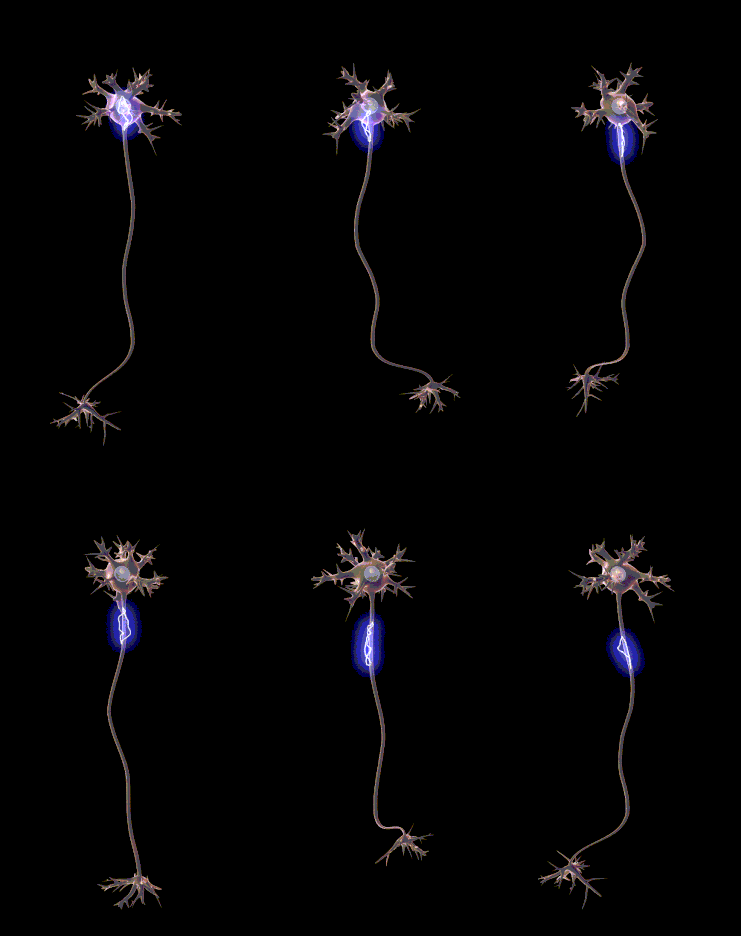
At the end of this axon, a chemical signal is released across tiny gaps called synapses to neighboring neurons. If the incoming signal into those neighboring neurons is strong enough, those also fire.
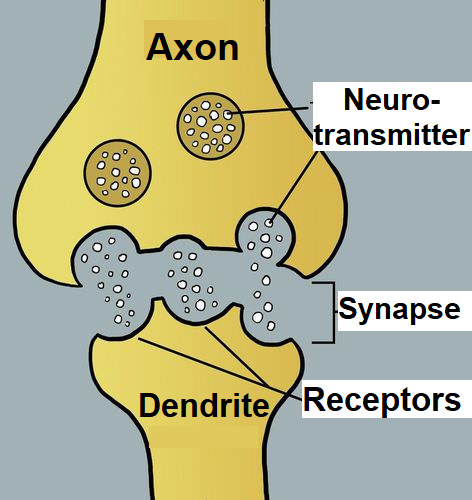
Whether a neuron fires depends on a few factors:
How strong the incoming signal is
How many signals arrive at the same time
How sensitive the receiving neuron is
When the same neurons activate together repeatedly, like seeing も while thinking or hearing “mo”, the connections between them gradually strengthen.
This is often summarized by a simple phrase from neuroscience:
“Neurons that fire together, wire together.”
This idea is known as Hebbian learning.
At a physical level, this strengthening happens in a few main ways:
The sending neuron releases more neurotransmitters
The receiving neuron becomes more sensitive to those signals
The connection itself becomes more efficient over time (this is shown in the gif above where the right neuron has been myelinated and the signal propagates more effeciently)
With enough repetition, these changes become long-lasting. Learning is literally physical changes happening in the brain!
So the natural next questions are:
How do you get the right neurons firing together? and,
How do you get them firing more often?
This is where how you study and what kind of immersion environment you build matters. Simply immersing yourself solves the problem of “more often”. In the next post we’ll abstract up from neurons and start talking about something known as mental representations and how this ties into the different types of immersion environments. This will lead us into how we get the “right” neurons firing together.