
Why You Should Immerse Yourself, Part 1: The Math
To learn Japanese effectively you will need many elements of the framework I’ll be building up in these blog posts. Immersion is an important part because if you simply increase your exposure to the language, you increase retention. But immersion doesn’t work on it’s own. You’ll need a way to learn words and phrases, to review them, and to learn to use them. For now though, let’s look at why you should even immerse.
The Math
The easiest way to understand why immersion works is just to look simply at the math. A straightforward comparison is the time a University student might be exposed to Japanese over a 4 year degree, versus the time a native 4 year old will have come into contact with Japanese (the average 4 year old human is able to hold basic conversations with mostly correct grammar. I have yet to meet a 4 year degree holder that was proficient at Japanese that didn’t do some kind of immersion, study abroad, etc). I’ll be making some assumptions here, but the exact number doesn’t matter. What matters is the relative difference.
I’ll use the Asian Cultures and Languages (Japanese) degree plan of my alma mater as a starting point. The degree plan suggests a minimum of 24 credit hours total with a minimum of 18 hours of upper-division course work. A common rule-of-thumb is to study 2 to 3 hours outside of class for each credit hour. If we combine these we can do a quick calculation on how much time the average Japanese student in this degree program might be exposed to Japanese.
Twenty-four credit hours averaged over 4 years comes out to 6 credit hours per year or three credit hours per semester. Each semester is 15 to 17 weeks. Now let’s walk through the calculation step-by-step:
The number of hours exposed to Japanese per week is: 3 credit/hours of Japanese class time + 3 hours for each credit hour which comes out to
3 + (3 * 3) = 12 hours / week
We can multiply this by the upper range of 17 weeks per semester to get the number of exposure hours per semester
12 hours / week * 17 weeks = 204 hours / semester
From this we can get the number of hours over all 8 semesters as
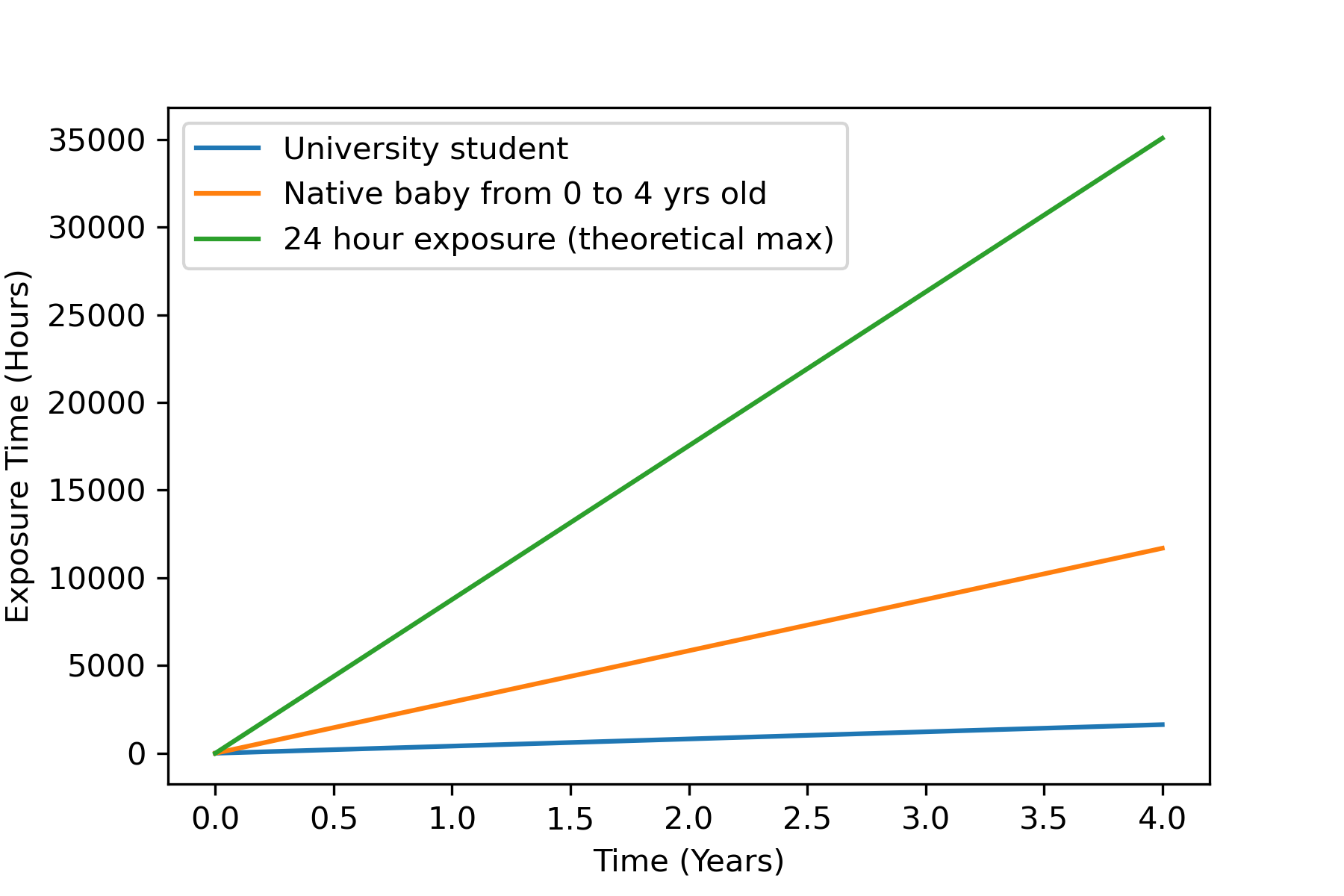
204 hours / semester * 8 semesters = 1,632 hours
Is roughly 2,000 hrs of exposure over 4 years a lot or a little? Let’s now compare this to the exposure a native baby might receive from the time they’re born to the time they turn 4 years old.
This calculation is much simpler. The only assumption we have to make is the average number of hours per day a baby might be exposed to their mother tongue. At the high end we could probably just assume that the average exposure is equal to the average number of waking hours. Most people when they are awake are either actively consuming content in their native language, or thinking in their native language. We’ll be a bit more conservative here and just assume that the exposure time is half of what the average person might endure while awake.
Assuming the average person sleeps 8 hours / night, the number of waking hours is 16 hours, half of which is 8 hours. Now the calculation:
To get the number of exposure hours per year we just multiply this by the number of days in a year:
8 hours / day * 365.25 days / year = 2,922 hours / year
Last, just multiply this times the number of years:
2,922 hours / year * 4 years = 11,688 hours
Rounding this up to 12,000 hours we get that the average native baby is being exposed to 6 times the amount of Japanese a University student is over the course of 4 years. This difference is illustrated in the figure below. There’s a huge difference between the 4 year old and the University student. Compared to the theoretical maximum exposure, the college student’s exposure level barely even registers.
This is just a comparison between University students and natives. If you think about the average Japanese learner that’s not a University student, they might be getting even less exposure. So why does exposure even matter? Exposure directly correlates to the number of times a neuron or group of neurons fire in the brain. Whether the connections between neurons strengthen or not depends on a lot of factors but basically, “neurons that fire together, wire together." This concept from Hebbian learning will be discussed in the next blog post.